Nervous System First Therapist: Why Who You Are in the Session Matters More Than What You Do
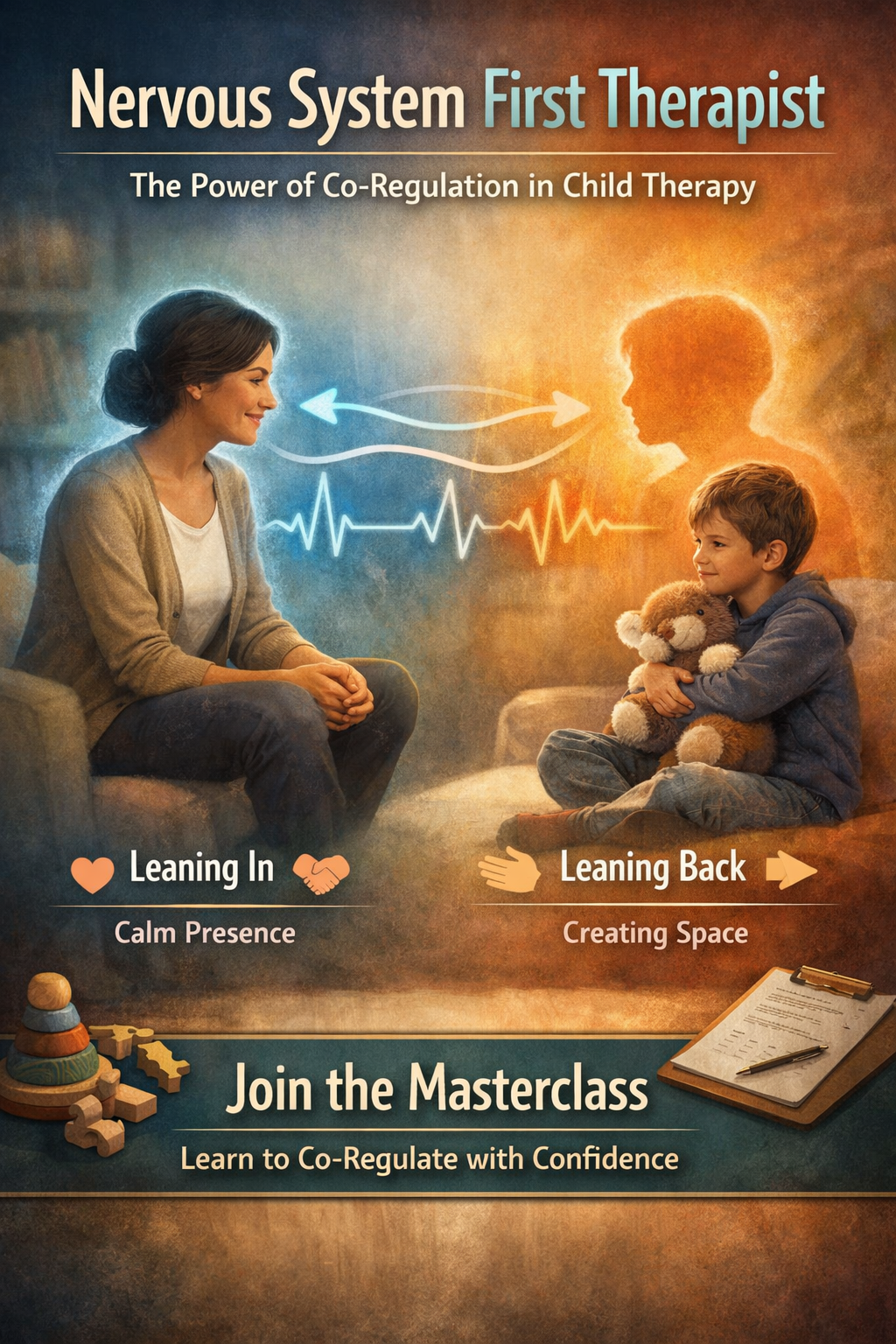
Being a co-regulator for your child….
In therapy, we often ask:
What strategy should I use next?
What hierarchy should I follow?
What cue or prompt will move this child forward?
But there’s a more foundational question—one that quietly determines whether any technique will work at all:
What nervous system state am I bringing into this session?
Before the child processes language, instructions, or goals, their body is scanning you.
Your tone.
Your posture.
Your pace.
Your breath.
Your presence.
This is the subtle science of co-regulation—and it is the missing piece in many therapy sessions.
Therapy Is a Nervous System Conversation (Whether We Acknowledge It or Not)
Children do not engage because we are skilled.
They engage because they feel safe enough to explore.
Safety is not a verbal concept.
It’s not created by reassurance, praise, or rewards.
Safety is communicated somatically—through the nervous system.
When a child enters your session, their body is asking:
Is this adult regulated?
Can I borrow their calm?
Is it safe to stay, explore, chew, speak, try, fail?
Your nervous system answers these questions before you ever start the activity.
The Therapist as a Co-Regulator (Not a Controller)
Traditional models often position the therapist as:
The director
The prompt-giver
The behavior manager
The skill-builder
A nervous-system-first lens reframes this entirely.
You are first and foremost:
A co-regulator.
This means:
Your body sets the emotional climate of the session
Your regulation becomes a template the child’s nervous system can sync with
Your presence either invites connection—or signals threat
This is why two therapists can use the same technique with completely different outcomes.
The difference is not knowledge.
It’s state.
Leaning In vs. Leaning Back: A Somatic Skill, Not a Script
One of the most misunderstood aspects of co-regulation is timing.
There are moments to lean in:
Offering proximity
Using warmth
Matching energy
Supporting engagement
And moments to lean back:
Creating space
Reducing demand
Slowing pace
Letting the child’s system settle
This is not something you decide cognitively in the moment.
It’s something you feel.
Co-regulation is an experiential skill—not a checklist.
Why This Can’t Be Taught as Pure Theory
You can memorize nervous system states.
You can read about safety cues.
You can intellectually understand regulation.
And still unknowingly bring tension, urgency, or pressure into the room.
Because the nervous system doesn’t respond to information.
It responds to embodied experience.
This is why so many therapists say:
“I know this concept… but I don’t know how to do it in session.”
What Nervous System–First Practice Actually Looks Like
A nervous system–first therapist learns to:
Track their own internal state during sessions
Notice subtle shifts in the child’s physiology
Adjust pace, posture, and proximity in real time
Use presence—not pressure—to support engagement
Regulate first, then teach
This approach doesn’t replace clinical skills.
It activates them.
When safety is present:
Feeding becomes exploratory
Communication becomes possible
Regulation precedes participation
Progress becomes sustainable
This Is the Work Beneath the Work
This is not about doing more in sessions.
It’s about becoming more intentional with:
Your body
Your energy
Your nervous system leadership
And once you learn this, it changes:
How sessions feel
How children respond
How you experience your work as a therapist
Ready to Learn This Experientially?
If this resonates, I’ve created a masterclass designed to teach this from the inside out.
Nervous System First Therapist – Masterclass
In this training, you’ll learn:
How to recognize your role as a co-regulator
How to read nervous system cues in real time
How to lean in and lean back with precision
Practical, in-session techniques to bring regulation into feeding, speech, and interaction
How to carry calm in your body so the child can borrow it
This is not a theoretical lecture.
It’s an experiential recalibration of how you show up in sessions.
Check out the Nervous System First Therapist Masterclass
https://www.yourspeechmatterspllc.com/nervous-system-first-therapist-tm
Because the most powerful tool you bring into therapy…
is you.